A custom DuckDB operator: SQL-first ingestion in Airflow
Building a custom Airflow operator that makes DuckDB the ingestion engine: SQL-first, testable, and cheap.
Voronoi postcodes data-engineering case study. Chapter: the DuckDB operator
This post documents the ingestion operator of my postcode-boundaries pipeline: why it was needed, how it is implemented, and what improved, including the three bugs an adversarial review found in my first version, all of which generalize.
Why a custom operator was needed
The ingestion stage of the pipeline used to be pandas loading inside python scripts: open a 618 MB JSON, build a DataFrame, apply a parse function, filter. It worked, but the ingestion logic was fused to the experiment code, untestable in isolation, and invisible to anyone who wanted to know what exactly lands in the data without reading a 400-line script.
The redesign: raw files flow into a DuckDB warehouse through SQL scripts, and a ~130-line custom operator is the only glue.
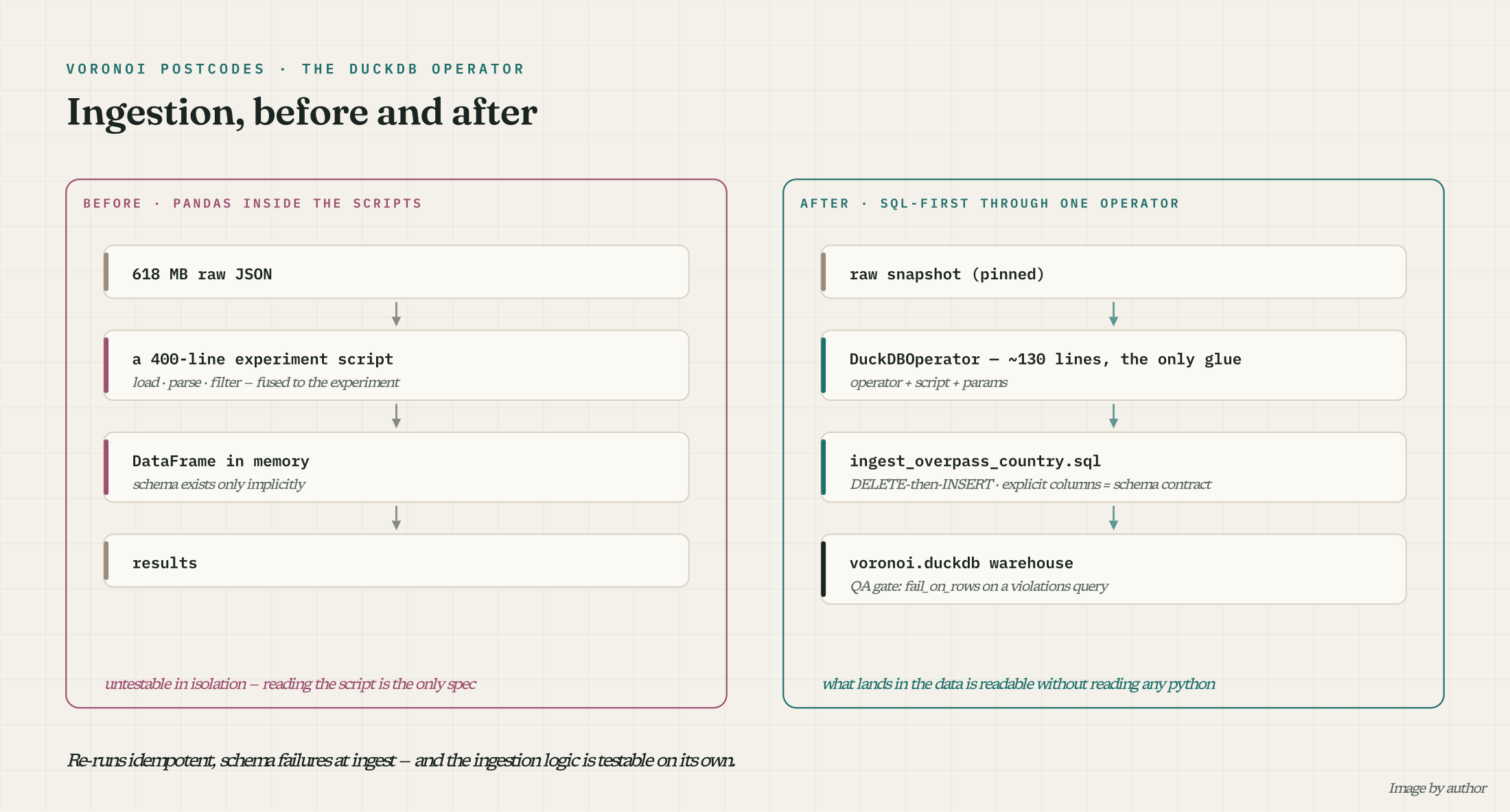 The redesign in one frame: what lands in the data becomes readable without reading any python. (Image by author)
How it was implemented
Operator + script + params
A task becomes operator + script + params:
DuckDBOperator(
    task_id="ingest_ch",
    database=f"{REPO}/data/warehouse/voronoi.duckdb",
    sql="ingest_overpass_country.sql",
    params={"country": "CH",
            "raw_path": f"{RAW}/CH_osm_addresses_raw.json",
            "batch_id": "{{ run_id }}"},
)
template_ext = (".sql",) means Airflow renders the script through Jinja from the DAG's template_searchpath, the same mechanism BashOperator uses for .sh files. The scripts live in the project repo, next to the data they describe, so a clone of the research repo can run them without Airflow (a 40-line build_warehouse.py renders the same params). DuckDB's native readers do the heavy lifting:
DELETE FROM raw_addresses WHERE country = '{{ params.country }}';

INSERT INTO raw_addresses
SELECT '{{ params.country }}', lat, lon, postcode_raw,
       '{{ params.raw_path }}', '{{ params.batch_id }}', current_timestamp
FROM read_json('{{ params.raw_path }}', format = 'array',
               columns = {lat: 'DOUBLE', lon: 'DOUBLE', postcode_raw: 'VARCHAR'});
The DELETE-then-INSERT makes re-runs idempotent, so a retry cannot double-count, and the explicit columns map is a schema contract: a malformed snapshot fails at ingest rather than three tasks downstream.
Hardening: three bugs, none of them typos
My first version of the operator was 87 lines and passed its manual test. A review pass whose only job was to refute it found three real defects, and none of them is specific to this operator.
1. sql.split(";") is not a SQL parser. The obvious way to run a multi-statement script (split on semicolons, execute each piece) shatters the moment a string literal or comment contains ;. DuckDB ships the fix:
statements = duckdb.extract_statements(self.sql)
for stmt in statements:
    cur = con.execute(stmt.query)
extract_statements uses the engine's own parser, and each statement object carries its type, which the third fix needs.
2. DELETE and INSERT ran in autocommit. If the INSERT failed (bad path, malformed JSON, OOM), the DELETE had already committed: the warehouse was left empty for that country, visibly corrupt until a retry healed it. The operator now wraps every write-mode script in one transaction:
con.execute("BEGIN TRANSACTION")
try:
    ...   # all statements
    con.execute("COMMIT")
except Exception:
    con.execute("ROLLBACK")
    raise
A committed test proves it: a script whose second statement fails leaves the table exactly as it was.
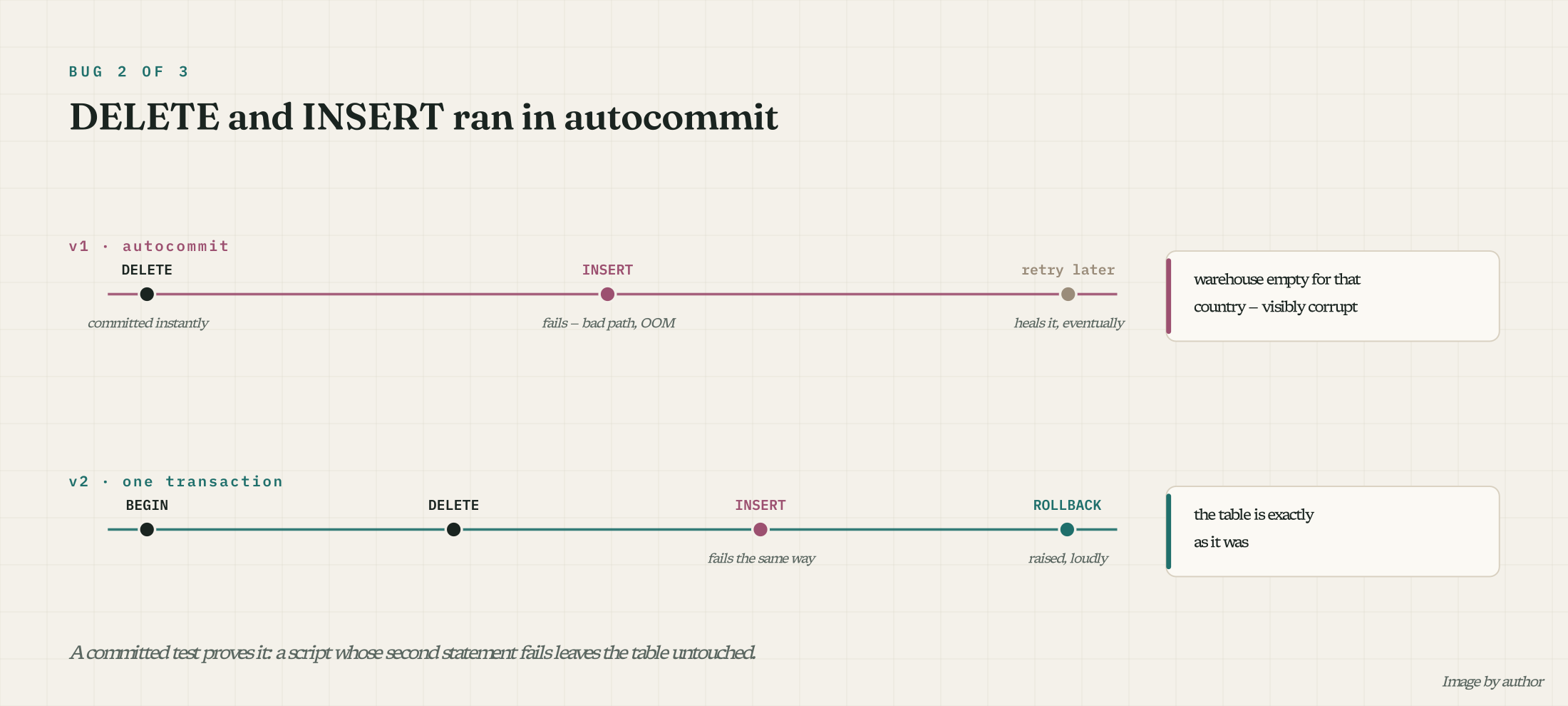 The same failure, two very different states left behind. (Image by author)
3. The QA gate triggered on the wrong statements. The operator has a fail_on_rows=True mode: point it at a violations-only SQL script and the task fails if the final query returns rows. My first implementation gated on "the last statement that produced a result set". But DuckDB DML also produces a result set (a one-row Count), so an ingest script under fail_on_rows would always fail on its own INSERT count. The contract is now explicit: the gate applies only when the final statement is a SELECT (stmt.type == duckdb.StatementType.SELECT), and a unit test pins exactly that behavior.
The QA gate as a data contract
fail_on_rows turns a SQL file into a data contract. The warehouse gate is a UNION of violation queries (empty result means clean):
SELECT 'raw_count_mismatch' AS violation, e.country,
       'expected exactly ' || e.n_raw_expected || ', found ' || coalesce(r.n_raw, 0)
FROM expectations e LEFT JOIN raw_counts r USING (country)
WHERE coalesce(r.n_raw, 0) != e.n_raw_expected
UNION ALL
SELECT 'parse_rate_out_of_band', ...
The expectations table is loaded from a committed CSV holding each pinned snapshot's exact row count and a calibrated parse-survival band. Exact counts beat thresholds: they catch double-ingestion (idempotency becomes observed, not assumed) and they cost nothing when the inputs are pinned. The band has a floor and a ceiling: a parse rate that jumps from 88% to 99% means a rule silently loosened, which no floor-only check would see.
One writing process per database file
DuckDB allows one writing process per database file: a second connect() fails on the file lock, immediately. Under Airflow's LocalExecutor, "five parallel ingest tasks" means five OS processes, so my original fan-out create >> [five ingests] >> qa was a guaranteed lock collision (reproduced with three subprocess writers: two die with IOException). The write chain is now sequential and says why in a comment; read-only consumers (read_only=True) parallelize freely once the writers are done. If you want the parallel look without the collision, a 1-slot Airflow pool serializes execution behind the scenes. I chose the explicit chain because the constraint deserves to be visible in the graph.
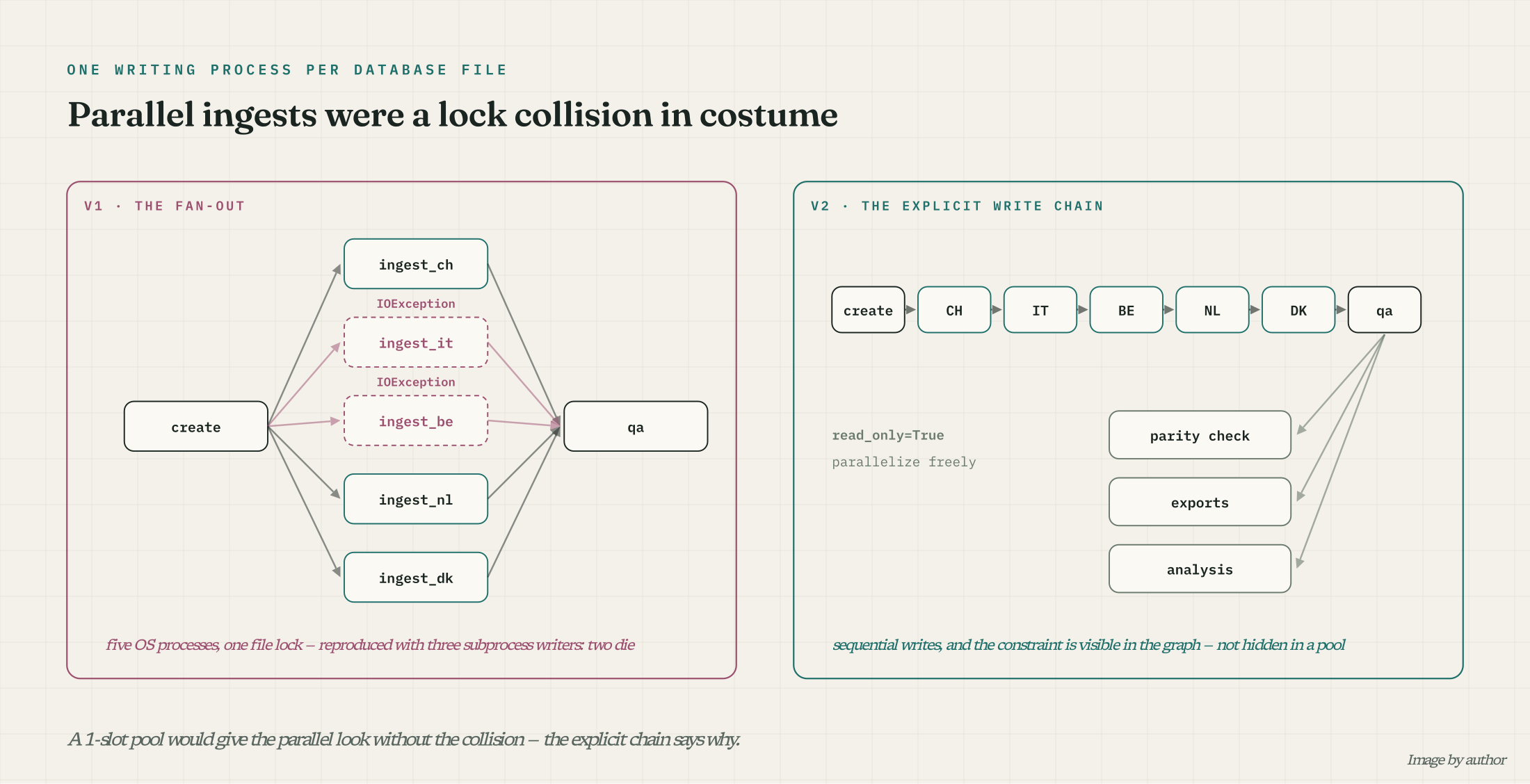 Five parallel writers was a lock collision wearing a parallelism costume. (Image by author)
What improved
Ingestion became readable. What lands in the data is a SQL file plus a params dict, not 400 lines of python.
The gate caught a real miscalibration on its first run. The first QA run failed its own naive 90% floor, because real OSM postcode noise sits at 86–88% in three of my five countries: thresholds come from observed baselines, not intuition.
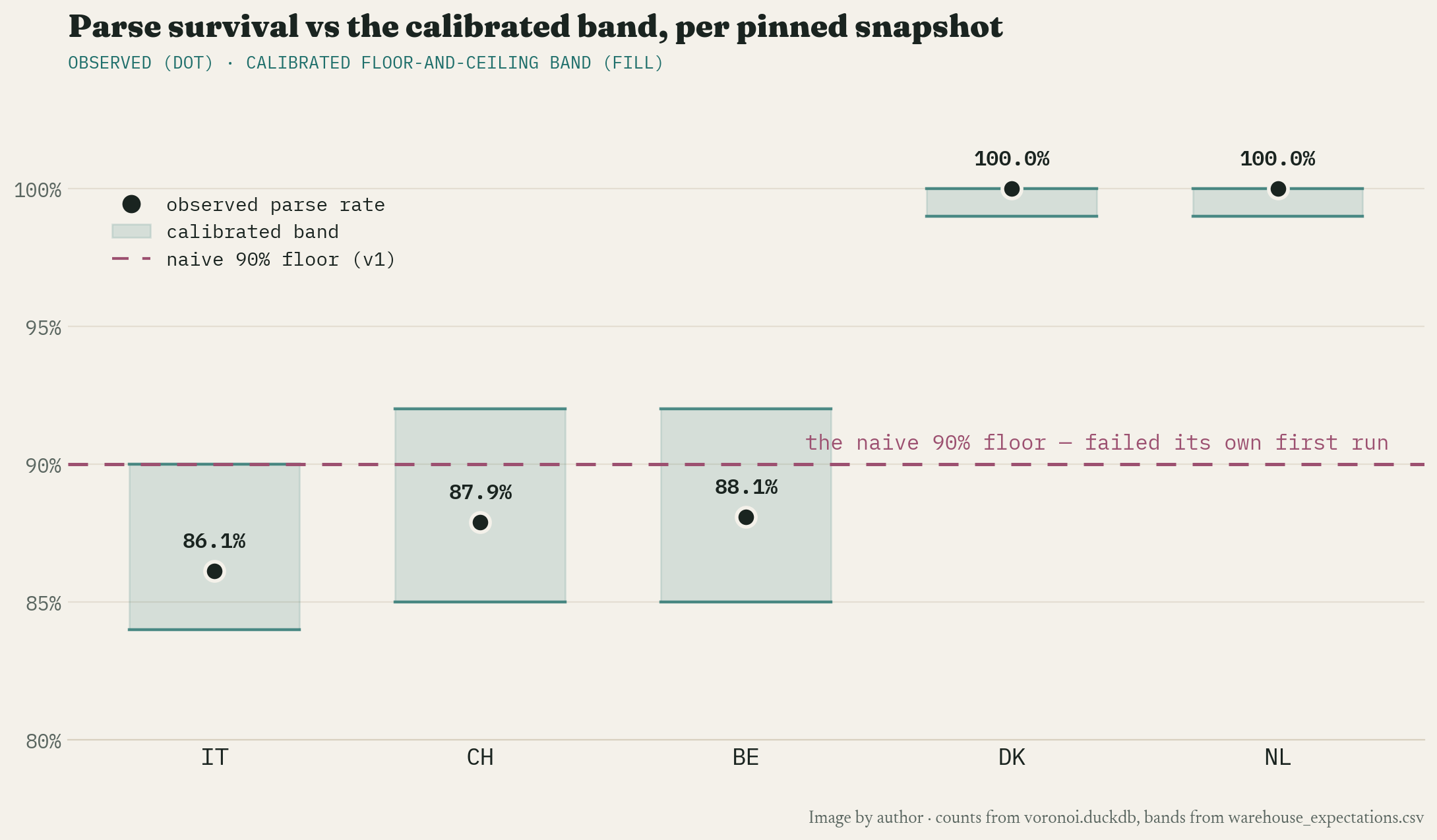 Real numbers from the warehouse: the naive 90% floor fails IT, CH and BE. The calibrated bands hold. (Image by author)
Failure got a defined shape. A malformed snapshot now dies at the ingest boundary instead of three tasks downstream, and a mid-script failure rolls back to the exact prior state rather than leaving a country's rows deleted with nothing in their place.
Although custom operators are cheap (subclass BaseOperator, implement execute), that cheapness tempts you to write them casually: the three bugs above all shipped in a version that "worked" on a happy-path manual test. What earned the operator its trust was the committed contract tests (semicolon-in-literal, rollback-on-failure, DML-never-gates, empty-gate-passes) and a review pass whose job was to break it. The operator is ~130 lines; the tests are ~90. That ratio feels right.
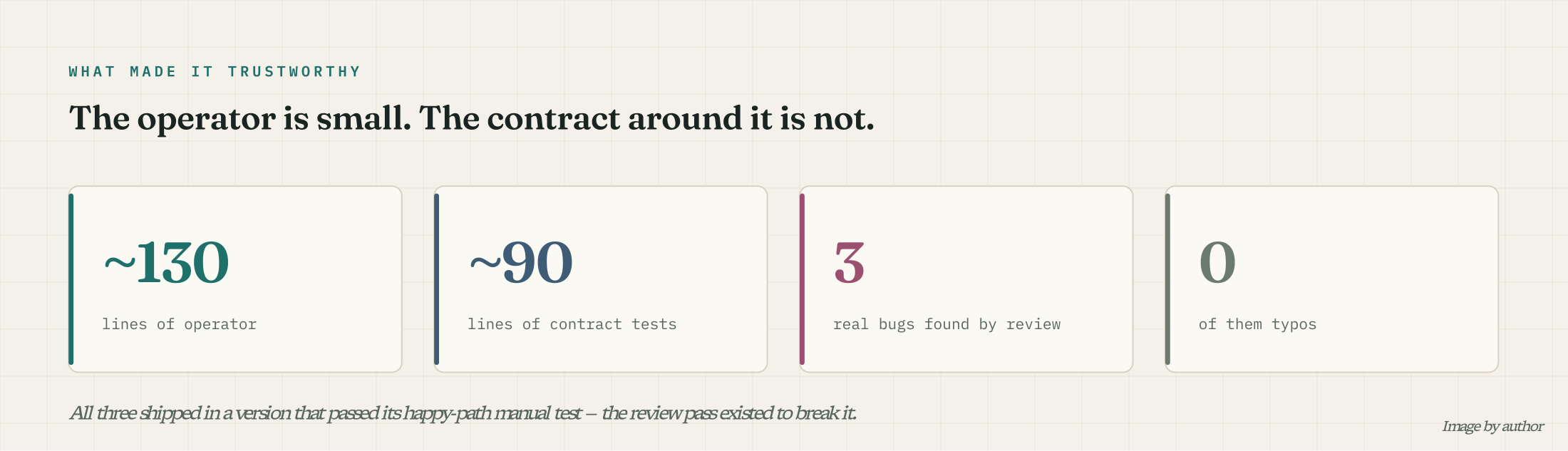 What made it trustworthy was never the operator. (Image by author)